To enhance the oversight and management of imported recycled pulp and advance the circular use of renewable resources, the General Administration of Customs, in collaboration with five other agencies including the National Development and Reform Commission, the Ministry of Industry and Information Technology, the Ministry of Ecology and Environment, the Ministry of Commerce, and the State Administration for Market Regulation, issued the Announcement on Regulating the Supervision and Administration of Imported Recycled Pulp (Announcement No. 200 [2025]) on October 17, 2025. The announcement took effect the following day, October 18, 2025. To facilitate a comprehensive understanding and accurate grasp of this announcement, key aspects are interpreted as follows.
I. Key Provisions
(I) Feedstock Requirements for Imported Recycled Pulp
The recycled pulp imported into China must be produced from source-separated paper, paperboard, and paper products of foreign origin. In addition, the imported recycled pulp shall comply with the requirements of Chinese national standard GB/T 43393.
(II) Requirements for Manufacturers and Traders of Imported Recycled Pulp
Manufacturers and traders of imported recycled pulp shall bear the primary responsibility for the quality and safety of their products. They shall operate lawfully and in good faith, conscientiously fulfill their social responsibilities, implement comprehensive management across the entire supply chain, covering feedstocks, production, processing, storage, and transportation, so as to protect national ecological and biological security.
(III) Requirements for Industry Associations
Industry associations shall provide stronger guidance to the sector, establish corporate integrity records, enforce strict oversight of their members, enhance self-regulation within the industry, and foster its healthy development.
(IV) Harmonized System Code for Imported Recycled Pulp
The Harmonized System (HS) code applicable to imported recycled pulp is 4706200000.
(V) Inspection Requirements for Imported Recycled Pulp
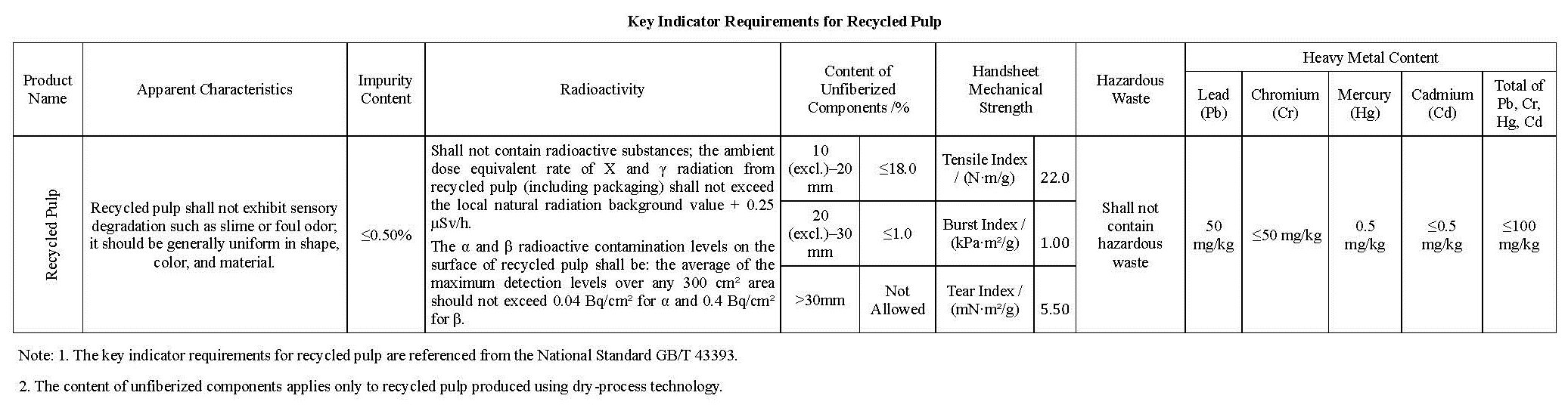
Key technical specifications for recycled pulp are set forth in the Annex to this Announcement. Customs authorities shall conduct sensory inspections of imported recycled pulp and test for these specified parameters in accordance with Customs testing protocols.
If Customs authority suspects that the imported recycled pulp may be solid waste, it may commission a qualified institution for waste characterization. Shipments confirmed as solid waste shall be subject to mandatory re-export as required by law. Furthermore, any violations of relevant laws and regulations will be pursued with legal liability.
(VI) Monitoring Requirements for Imported Recycled Pulp
Customs authorities shall conduct risk monitoring and assessment for imported recycled pulp and dynamically adjust the relevant inspection and monitoring criteria.
(VII) Responsibilities of Relevant Government Departments
In accordance with their respective mandates, the relevant competent government departments shall strengthen supervision over imported recycled pulp, enhance inter-agency communication and coordination, and ensure a cohesive enforcement effort.
II. FAQs On Key Issues
Question 1: How should enterprises implement quality control for imported recycled pulp?
Enterprises shall bear the primary responsibility for the quality and safety of their products. This includes: strengthening oversight of feedstock sources and implementing rigorous production process controls for recycled pulp; conducting rigorous in-house quality inspection; operating lawfully and in good faith, and complying with all applicable laws, regulations, as well as the requirements of this Announcement. The objective is to ensure that all imported recycled pulp conforms to the Chinese national standard GB/T 43393.
For example, used domestic paper products such as napkins, toilet paper, and paper cups do not qualify as the “source-separated paper, paperboard, and paper products” specified in this Announcement and may not be used as feedstock for imported recycled pulp.
Question 2: Under what circumstances will imported recycled pulp be re-exported, and what happens if it is identified as solid waste?
Customs authorities shall inspect imported recycled pulp for the key parameters specified in the Annexto the Announcement, in accordance with Customs testing protocols. Shipments that fail inspection are subject to re-export or destruction. Materials identified as solid waste shall be re-exported as required by law. Enterprises found in violation of relevant laws and regulations will also face legal liability.
For instance, imported recycled pulp containing prohibited materials (e.g., metals, plastics, or glass) in excess of the 0.50% limit set in this Announcement will be re-exported or destroyed. Where the level of such prohibited materials substantially exceeds this limit, the material may furtherbe subject to waste characterization and deemed solid waste. Likewise, shredded or fragmented waste paper that has just undergone simple sorting, shredding, or baling is considered solid waste and is prohibited from import.
Question 3: What should be noted when declaring imported recycled pulp?
The Harmonized System (HS) code for imported recycled pulp is 4706200000. Pursuant to Announcement No. 195 [2025] of the General Administration of Customs, when declaring imported recycled pulp, importers or their agents must specify the manufacturing processused in its production as either “dry process” or “wet process”in the remarks field of the Customs declaration, indicating the method actually employed. To facilitate clearance and port inspection, Customs reminds that recycled pulp produced by different processes must not be combined in the same shipment.
(Prepared by: Department of Commodity Inspection, Tianjin Customs, Shijiazhuang Customs, Qingdao Customs, Shenzhen Customs, and Chongqing Customs)
Disclaimer:The above content is translated from Chinese version of GACC. The GACC version shall prevail.
Hot News