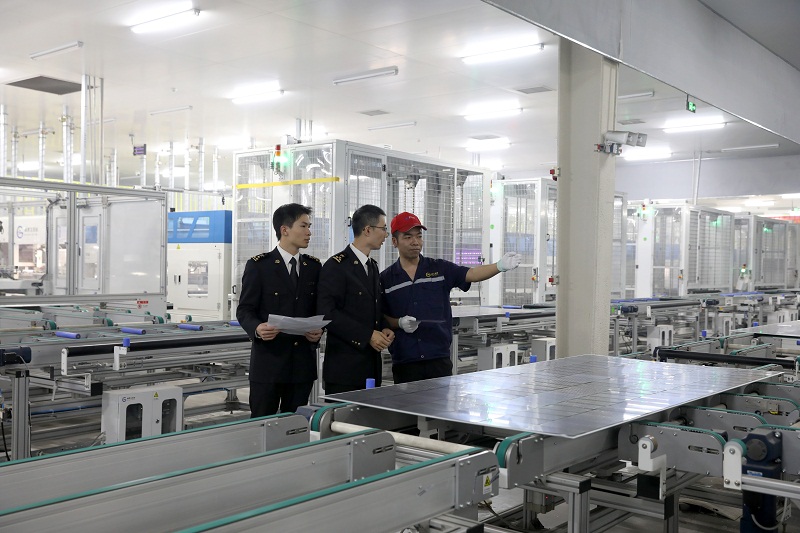
[Image: Customs officers conduct research at a photovoltaic manufacturer. Photographer: Guan Yue]
According to statistics released by Guangzhou Customs, the city's import and export value with partner countries under the Belt and Road Initiative (BRI) reached 531.24 billion yuan in the first 11 months of the year, a year-on-year increase of 24 percent. This solid trade performance underscores the growing importance of BRI partners to Guangzhou's economy.
The production workshop of Guangzhou Gokin Solar Technology Co. Ltd. in Huadu District hums with activity, where workers are systematically packing the final batches of solar modules. “By closely tracking demand in the power sector within BRI markets, we have developed new battery modules designed to maximize light-to-electricity conversion and minimize power loss,” said Dong Xiaoting, director of the company’s Operations Support Center.
To facilitate the efficient export of photovoltaic products and other items within the "New Three" categories, Guangzhou Customs has been proactively collecting feedback and resolving bottlenecks in the cross-border logistics chain for companies. The effort includes advancing the "One Port Access in the GBA" initiative - a key logistics integration reform in the Guangdong-Hong Kong-Macao Greater Bay Area - which strengthens coordination between inland terminals along the Pearl River and coastal ports like Nansha Port, and enables rapid Customs clearance with a single declaration.
Similarly, Guangzhou FIIO Electronics Technology Co., Ltd., a high-tech enterprise specializing in in-house R&D and production of portable audio products, has actively cultivated emerging markets in recent years, with a focus on Belt and Road partner countries, and has seen more than 40 percent of its orders come from these markets in the first eleven months of this year alone.
To help local businesses accelerate their overseas expansion, Guangzhou Customs has rolled out targeted campaigns to facilitate cross-border trade, introducing support measures based on enterprise feedback. Through a collaborative model that brings together Customs, local governments, and industry associations, it guides more specialized, sophisticated, and innovative "little giant" enterprises in obtaining Authorized Economic Operator (AEO) status. This helps lower their operational costs and steadily expands their network of international trade partners.
Yang Fan, Deputy Director of the Department of Statistical and Analysis of Guangzhou Customs, noted that trade and industrial cooperation between Guangzhou and Belt and Road partner countries have strengthened significantly this year. The closer ties, according to Yang, are reflected in rising textile exports and agricultural imports between Guangzhou and these markets. (By Guan Yue)
Related News
Boosting High-Quality Cooperation Between China and CEE Countries
2025-12-04
Ningbo, home to China's first China-CEEC Economic and Trade Cooperation Demonstration Zone, achieved a high average annual growth rate of 20.1% in trade with CEECs during the 14th Five-Year Plan period.

Shanghai’s Import-export Volume with the Belt and Road Initiative (BRI) Partner Countries Tops 1.21 Trillion Yuan in Jan-Aug
2025-09-24
Shanghai’s imports and exports with countries participating in the Belt and Road Initiative (BRI) reached 1.21 trillion yuan in the first eight months of this year, up 12.6 percent year-on-year.
Hot News